
NOW PLAYING: The Miracle on 34th Street (1955 version)
/
Following a brief hiatus in November, the team at GME is pleased to offer new programming this month in the Adrienne Mancia Streaming Room. Just in time for the holiday season, we bring you the little-seen 1955 made-for-television remake of the Christmas classic MIRACLE ON 34TH STREET (1947).
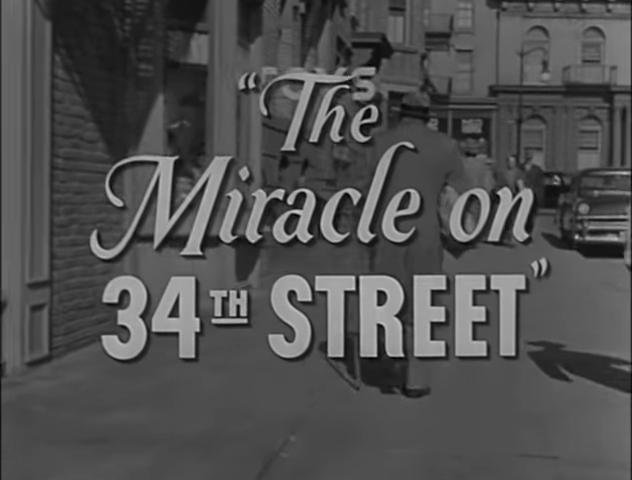
TITLE CARD FROM THE 1955 TV ADAPTATION OF THE MIRACLE ON 34TH STREET.
Featuring the talents of Academy Award winners Teresa Wright and Thomas Mitchell alongside Emmy Award-winner MacDonald Carey, THE MIRACLE ON 34TH STREET takes place between Thanksgiving and Christmas Day in New York City and follows Kris Kringle (Mitchell), a department store Santa Claus who claims to be the real Saint Nick. Event director and recent divorcee Doris Walker (Wright) and her young daughter Susan (Sandy Descher) befriend Kringle after Doris convinces him to play Santa in the Macy’s Thanksgiving Day Parade. However, Kringle’s attempts to convince others that he is the real Santa nearly places him in a mental hospital. Attorney Fred Gailey (Carey), Doris’ neighbor and eventual love interest, agrees to represent Kringle in court and prevent his institutionalization.
MIRACLE ON 34TH STREET was originally produced as a feature film in 1947 by 20th Century Fox. Written and directed by George Seaton from an original story by Valentine Davies, the film starred Edmund Gwenn as Kris Kringle, Maureen O’Hara as Doris, John Payne as Fred, and future Oscar-nominee Natalie Wood (in one of her earliest movie roles) as Susan. A critical and commercial success, the film won three Oscars (including Best Supporting Actor for Gwenn) and quickly became a Christmas classic. In 2005, the Library of Congress added MIRACLE ON 34TH STREET to the National Film Registry for its “cultural, historic, and aesthetic significance,” and four years later the film was preserved by the Academy Film Archive.
MIRACLE ON 34TH STREET has been remade several times since 1947. The original film itself was altered (controversially) when it became one of the first feature-length, black-and-white films to be colorized during the 1980s colorization boom spearheaded by Ted Turner. In 1959, an hour-long, color TV adaptation of the film was broadcasted on NBC and starred Ed Wynn as Kris Kringle, Mary Healy as Doris, Peter Lind Hayes as Fred, and Susan Gordon as Susan. In 1963, the story was adapted into a short-lived Broadway musical with book and lyrics by Meredith Willson. Ten years later, the film was once again remade for television — this time as a 100 minute-long broadcast for CBS — and starred Sebastian Cabot, Jane Alexander, David Hartman, and Roddy MacDowell. Perhaps the most famous remake of the film was the 1994 theatrically-released version directed by Les Mayfield, produced and co-written by John Hughes, and starring Richard Attenborough as Kris Kringle, Elizabeth Perkins in the Doris Walker role (as “Dorey Walker”), Dylan McDermott in the Fred Gailey role (as “Bryan Bedford”), and Mara Wilson as Susan.
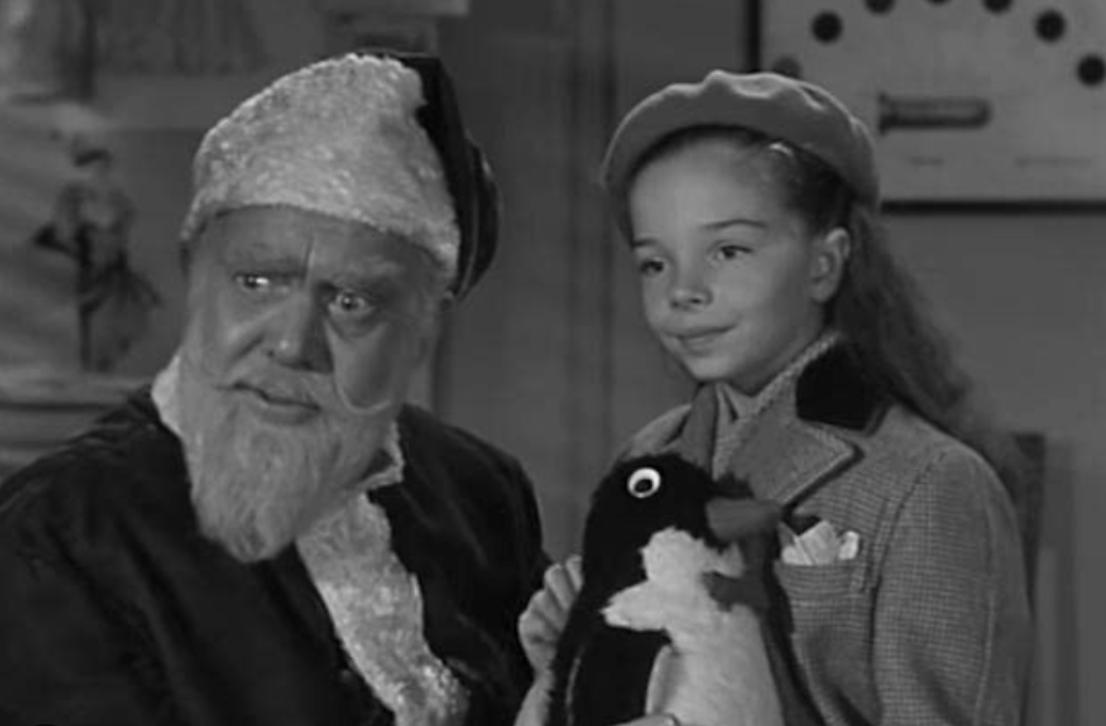
THOMAS MITCHELL AND SANDY DESCHER IN THE MIRACLE ON 34TH STREET (1955).
This 1955 version was the first remake of MIRACLE ON 34TH STREET and for many years was one of the lesser-seen versions of the story. With the advent of the Internet and streaming, long-lost gems from the first “Golden Age of Television” (1947—56) have resurfaced en masse, in large part due to their public domain status resulting from lapsed or nonexistent copyrights. This nascent and highly innovative period in American television (which predates the talk- and game show-heavy “network era” of the 1960s—1980s) saw the promulgation of high-brow and critically-acclaimed teleplays and telecasts, including both live and pre-recorded anthology series such as Playhouse 90, Kraft Television Theatre, and The 20th Century Fox Hour. This version of MIRACLE ON 34TH STREET was produced by Fox (like the original 1947 film) and broadcasted on The 20th Century Fox Hour on December 14, 1955.
MIRACLE ON 34TH STREET was one of several intellectual properties in mid-century American entertainment that was reproduced in various “versions” for different studios, networks, and formats. A comparable example is THE MIRACLE WORKER. Playwright William Gibson first wrote THE MIRACLE WORKER as a 1957 teleplay for Playhouse 90 that, like THE MIRACLE ON 34TH STREET, starred Teresa Wright. As with MIRACLE ON 34TH STREET, THE MIRACLE WORKER was subsequently remade numerous times for film, stage, and television. The various versions of both MIRACLE ON 34TH STREET and THE MIRACLE WORKER demonstrate that Hollywood, Broadway, and TV have always had a penchant for recycling pre-existing IP for new audiences. This practice is evident nowadays in the plethora of remakes and reboots produced by companies like Disney, and within big-budget, high-concept franchises like the Marvel Cinematic Universe.

ACTRESS TERESA WRIGHT.
It is also worth noting the significance of Oscar-winning stars like Teresa Wright appearing so frequently in 1950s TV productions such as MIRACLE ON 34TH STREET and THE MIRACLE WORKER. Wright found fame in the studio system of Hollywood’s Golden Age, the apotheosis of which occurred in the late 1930s and early ‘40s. Discovered as a theater actress in 1939 by movie mogul Samuel Goldwyn, Wright was signed to a long-term contract at MGM and quickly accrued three Oscar nominations for her performances in THE LITTLE FOXES (1941), MRS. MINIVER, and THE PRIDE OF THE YANKEES (both 1942), winning the Best Supporting Actress award for MRS. MINIVER. A year later, she would star opposite Joseph Cotten and MacDonald Carey (her future leading man in THE MIRACLE ON 34TH STREET) in Alfred Hitchcock’s classic thriller SHADOW OF A DOUBT (1943). However, by the early 1950s, Wright and many of her contemporaries found their film careers waning. This was due partly to aging (although Wright was only 37 when she starred in THE MIRACLE ON 34TH STREET, a woman in her mid-30s was considered “middle-aged” and therefore less “desirable” by Hollywood standards). It was also due to the broader dissolution of the studio system that stars like Wright had been brought up in, largely resulting from the rising popularity of television.
In 1950, only about nine percent of American households had a television. By the end of the decade, that number had exploded to 90 percent. Television’s ubiquity and accessibility — allowing for viewers to watch teleplays and serials from the comfort of their homes — led to a decrease in box office traffic. With the hopes of luring the American public out of their living rooms and back into the movie theaters, major studios implemented with such extravagant cinematic strategies as CinemaScope (satirized in Frank Tashlin’s splashy Hollywood comedies THE GIRL CAN’T HELP IT [1956] and WILL SUCCESS SPOIL ROCK HUNTER? [1957]) as well as 3-D projection (think Andre de Toth’s 1953 horror film HOUSE OF WAX and Alfred Hitchcock’s 1954 thriller DIAL M FOR MURDER).
In other words, the movies underwent a “makeover” in the 1950s, and this “makeover” extended beyond mere visual inventiveness. Actors of the previous generation, like Wright, were de-prioritized in favor of younger, flashier, and overtly “sexier” stars like Marilyn Monroe, Jayne Mansfield, Rock Hudson, and James Dean. It also didn’t help that Wright in particular had a very public falling out with Samuel Goldwyn in 1948 over the terms of her MGM contract and the limitations that were being placed on her (and her contemporaries) by the studio system in general. Around this time, Wright remarked: “The types of contracts standardized in the motion picture industry between players and producers are archaic in form and absurd in concept.”
In short, the studio system was beginning to crumble, and increasingly snubbed actors like Wright were more than happy to leave it behind and find work elsewhere. For Wright, this proved to be a fruitful departure: her work on television in the 1950s earned her two Emmy nominations, and beginning in the 1960s, she mounted a successful career on the New York stage that culminated in a Drama Desk Award for her role in the 1980 revival of Arthur Miller’s DEATH OF A SALESMAN.