
NOW PLAYING: The Glass Menagerie (1966 TV Version)
/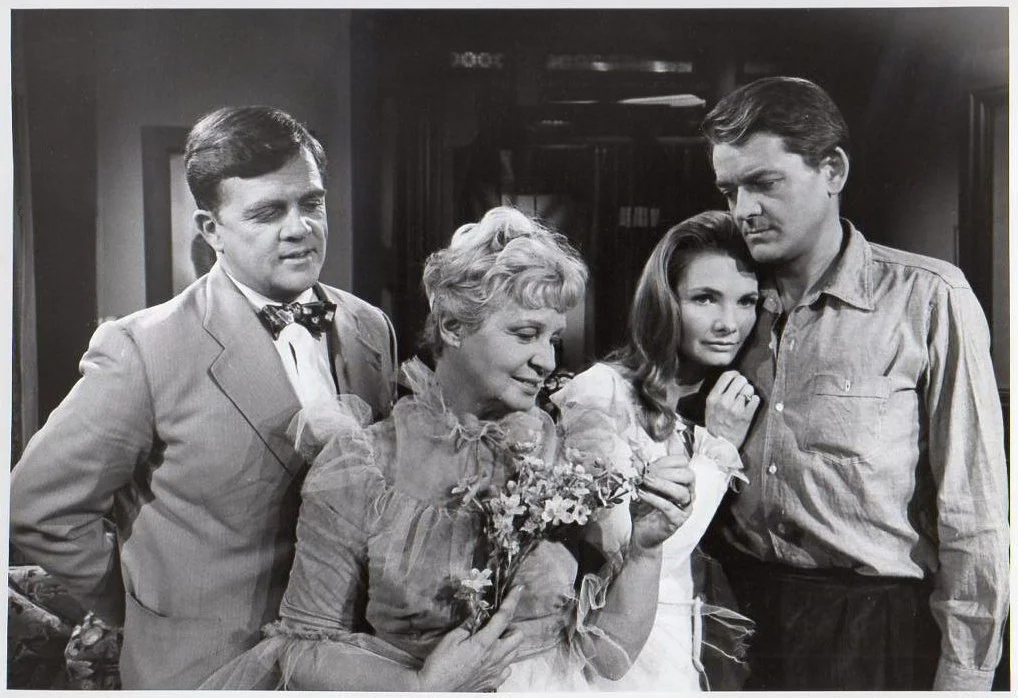
HAL HOLBROOK, SHIRLEY BOOTH, BARBARA LODEN, AND PAT HINGLE IN A PROMOTIONAL STILL FOR CBS’ THE GLASS MENAGERIE (1966).
CLICK THE IMAGE ABOVE TO VIEW THE GLASS MENAGERIE IN FULL.
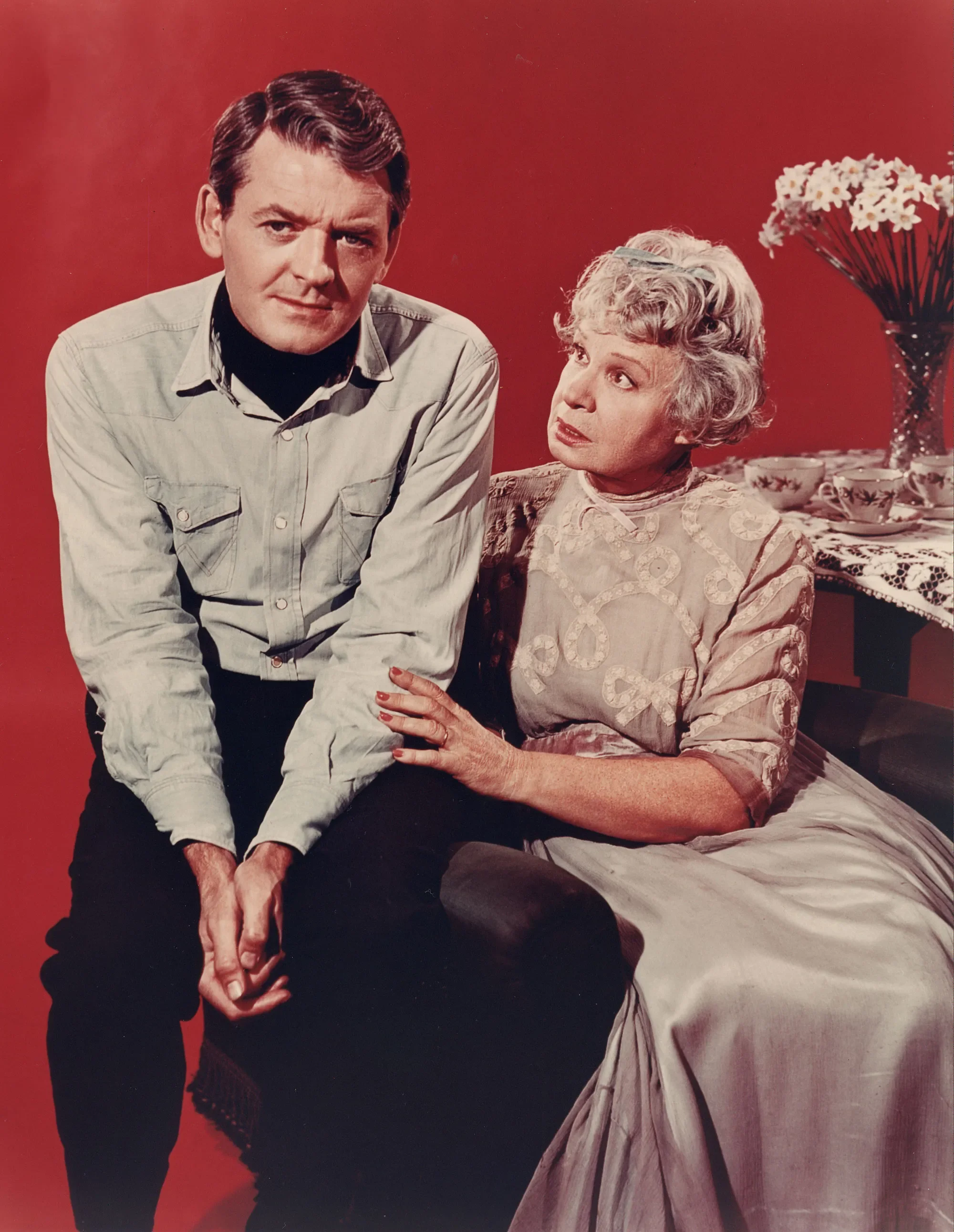
HAL HOLBROOK AND SHIRLEY BOOTH IN A PROMOTIONAL STILL FOR CBS’ THE GLASS MENAGERIE (1966).
On December 5th, GME presented the little-seen 1955 television remake of THE MIRACLE ON 34TH STREET in the Adrienne Mancia Streaming Room. This month, GME presents another little-seen television remake of a classic story that has been reproduced numerous times for screens big and small: the 1966 CBS Playhouse broadcast of Tennessee Williams’ play THE GLASS MENAGERIE.
THE GLASS MENAGERIE is a semi-autobiographical memory play chronicling the disintegration of the Wingfield family — mother Amanda, daughter Laura, and son Tom — in the wake of their patriarch, Mr. Wingfield’s, abandonment. Amanda is a faded Southern belle whose comfortable and privileged upbringing represents a bygone era as she struggles to provide for her family under harsh socioeconomic conditions. Tom, the main breadwinner of the family in his father’s absence, toils away at a shoe factory but longs for the life of a poet and often tries to escape his dysfunctional home life through nightly outings to the movies. Laura, meanwhile, suffers from a limp and an inferiority complex following a childhood illness. These ailments have rendered her fragile and isolated, and forced her to retreat into her own world — a microcosm of which are her collection of glass animal figurines. The play culminates in Laura being visited by a “gentleman caller,” former classmate Jim O’Connor. Despite his former popularity as a high school athlete, Jim now works at the same shoe factory as Tom and must contend with his own unrealized dreams.
Williams’ play premiered in Chicago on December 26, 1944, earning critical acclaim before transferring to Broadway the following year. (The play has since been revived on Broadway several times; most recently, in 2017, starring Sally Field). In 1955, Warner Bros. distributed the first theatrically-released film adaptation of the play. Directed by Irving Rapper, this adaptation starred Arthur Kennedy as Tom, Gertrude Lawrence as Amanda, Jane Wyman as Laura, and Kirk Douglas as Jim. A second theatrical film adaptation was released in 1987 by Cineplex Odeon Films. Directed by Paul Newman, this version starred Newman’s wife Joanne Woodward as Amanda, alongside John Malkovich as Tom, Karen Allen as Amanda, and James Naughton as Jim.
For years, the best-known (and most accessible) TV verison of THE GLASS MENAGERIE was an ABC production originally broadcast on December 16, 1973. Katharine Hepburn starred as Amanda, alongside Sam Waterston as Tom, Joanna Miles as Laura, and Michael Moriarty as Jim. This version was a critical and ratings success, with all four actors earning Emmy nominations for their performances. Prior to this 1973 version, CBS Playhouse broadcasted version in 1966, shot on videotape and starring Shirley Booth as Amanda (in an Emmy-nominated performance), Hal Holbrook as Tom, Barbara Loden as Amanda, and Pat Hingle as Jim. For decades, this telecast — which only aired once despite being acclaimed by The New York Times as “an evening of superb theater” — was thought to be lost.
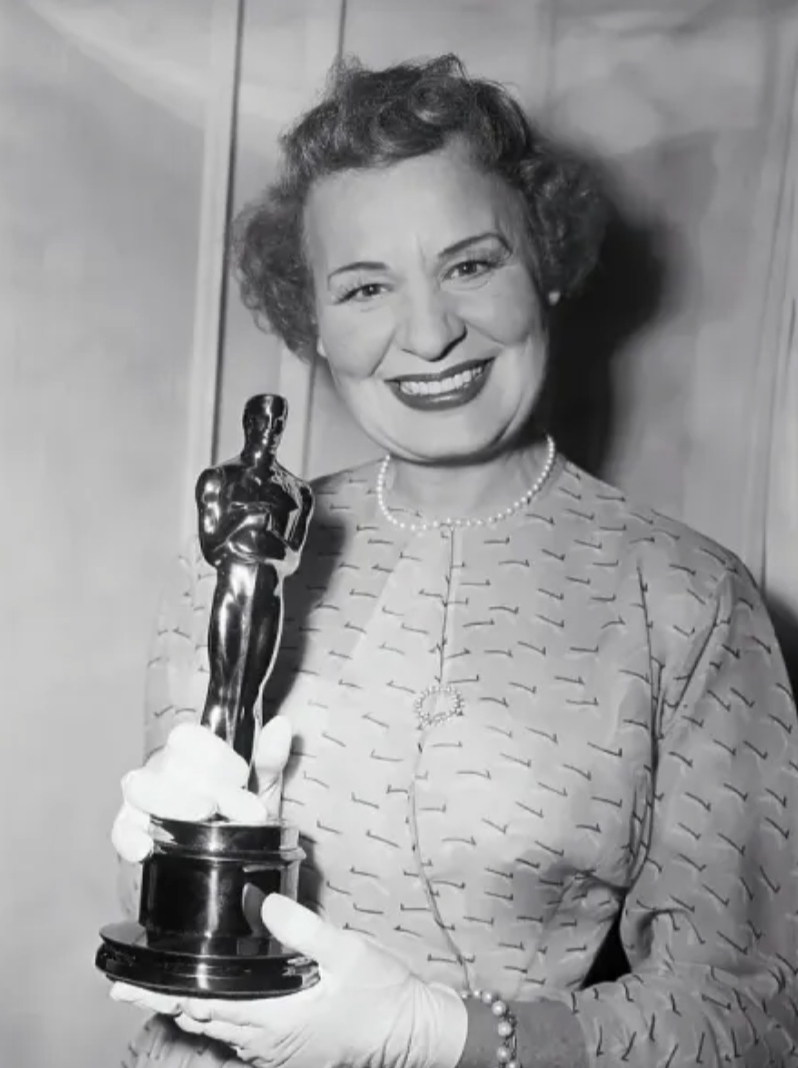
SHIRLEY BOOTh, HOLDING HER BEST ACTRESS OSCAR, 1952.
Jane Klain, a friend and colleague of GME’s and the “indefatigable” (to quote author and columnist Michael Shulman) research manager at the Paley Center for Media, had for years received numerous requests from scholars, researchers, and historians to view this long-elusive version of THE GLASS MENAGERIE. Klain — who recalled seeing this version when it was first broadcast in 1966 — attempted to track down the original tapes, to no avail. “It just didn’t exist,” Klain noted in a 2016 interview for The New Yorker. “We looked in the bizarre little archives that sometimes things turn up in. Nowhere.” Klain also tried the Estate of David Susskind, who produced the telecast, as well as the archives at CBS, the Library of Congress, and Xerox (which sponsored the broadcast). She even contacted Elia Kazan, who had been married to Barbara Loden, but all efforts proved fruitless.
Finally, in the fall of 2015, Klain managed to track down six hours of pristine, unedited takes of the 1966 GLASS MENAGERIE telecast in the archives at the University of Southern California. This discovery, however, proved problematic. Without a copy of the final telecast available as a reference, it would be impossible to accurately piece together these unedited takes into the 104-minute production that originally aired on CBS. Miraculously, Klain stumbled upon bootleg audio of the original telecast that someone had recorded off of their television set in 1966, and later uploaded to the Internet Archive. Using this audio track as an editing framework, Klain and preservationist Dan Wingate spent over 20 hours combing through the raw videotapes and stringing the correct shots together. Eventually, the film was reassembled and broadcast on Turner Classic Movies — for the second time ever — on December 8th, 2016: 50 years to the day after its original airing.
The rediscovery and reconstruction of 1966’s THE GLASS MENAGERIE is a feat of archival excavation and film preservation. Over the last 25 years, GME has scoured commercial storage facilitates and uncovered a number of rare or best-quality nitrate elements, which have been repatriated and preserved by archives around the world. For example, GME discovered and excavated nitrate 35mm film elements of Leopold Lindtberg’s 1944 feature SWISS TOUR in a New York City warehouse. As noted by GME President Jon Gartenberg: “The [nitrate 35mm film elements] proved to be the best known surviving physical elements in the entire world; thus, archival work not only involves the discovery of 'lost' films, but also identifying the highest quality celluloid elements that are to be used as preservation master material. In 2006, my company repatriated these materials to the Cinémathèque suisse in Lausanne; the film was subsequently preserved in 35mm, and the World Premiere restoration was shown at the Locarno Film Festival in August 2007.” As with the 1966 version of THE GLASS MENAGERIE, Lindtberg’s film — once virtually inaccessible — now has a new life in the 21st century. (SWISS TOUR, which screened for free in the Adrienne Mancia Streaming Room last August, can be purchased as a DVD or DSL file from GME).
The various versions of THE GLASS MENAGERIE demonstrate that Hollywood, Broadway, and TV have always had a penchant for recycling pre-existing intellectual property for new audiences. In the 1950s and ‘60s in particular, TV remakes of older IP provided employment for an older generation of A-list Hollywood actors (particularly women) who were being passed over for younger, flashier talent amid the dissolution of the studio system and the rise of New Hollywood. Shirley Booth, who for years worked predominantly in theatre, made her film debut in 1952’s COME BACK, LITTLE SHEBA and won an Academy Award for her performance. She made her last film appearance in 1958 before working almost exclusively in television until her retirement in 1974. Teleplays like THE GLASS MENAGERIE allowed thespians like Booth to continue to act in prestigious fare long after their glory days on the silver screen had ended.
—Matt McKinzie
Following our original post, GME colleague Jane Klain informed us that the kinescope of the 1966 broadcast of THE GLASS MENAGERIE was subsequently found and preserved. This restoration is the version that is now available to view in the Adrienne Mancia Streaming Room, which underscores the importance of identifying the best quality archival materials (as we explained above regarding SWISS TOUR).