
NOW PLAYING: Ken Jacobs' CYCLOPEAN 3D: LIFE WITH A BEAUTIFUL WOMAN
/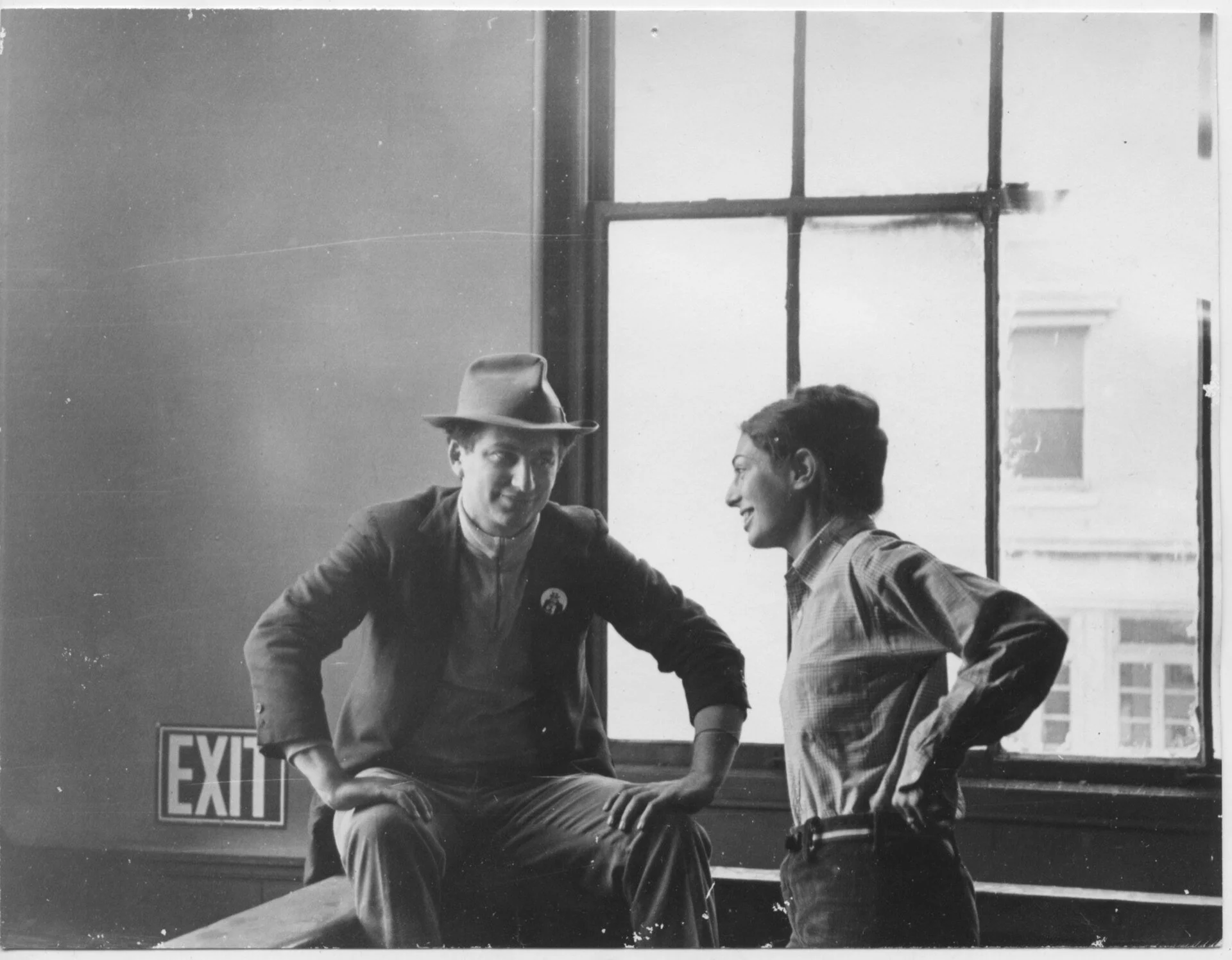
KEN AND FLO JACOBS AT THE ORIGINAL LOCATION OF MILLENNIUM FILM WORKSHOP, NOW ANTHOLOGY FILM ARCHIVES. PHOTO BY MICHAEL SNOW.
Ken and Flo Jacobs, titans of avant-garde film for over 60 years, both passed away in 2025 at the ages of 92 and 84, respectively. Their lives and legacies will be celebrated this month with the tribute series The Whole Shebang: Celebrating Ken and Flo Jacobs, organized by Andrew Lampert. A number of Ken and Flo’s filmic collaborations will screen at various venues across New York City, including The Museum of Modern Art, Anthology Film Archives, Metrograph, and Film at Lincoln Center. The final in-person programs will screen at Millennium Film Workshop (which Ken founded in 1966) and The Film-Makers’ Cooperative. Ken and Flo were among the original founders of the Coop in 1961 — the same year they met and began a personal and creative partnership that lasted over 60 years.
In 2012, GME funded and produced Ken Jacobs’ film CYCLOPEAN 3D: LIFE WITH A BEAUTIFUL WOMAN through the Experimental Filmmakers Production Fund. As part of this city-wide tribute to Ken and Flo, GME is proud to present CYCLOPEAN 3D in the Adrienne Mancia Streaming Room. Mancia was a renowned MoMA film curator who was an early champion of Jacobs’ work.
Born and raised in Brooklyn, New York, Ken Jacobs studied with abstract expressionist painter Hans Hofmann, whose emphasis on depth and dimensionality had a significant impact on his work as a filmmaker. As noted by Amy Taubin in Artforum: “Hofmann’s injunction to ‘manifest a three-dimensional event on a two-dimensional surface’ has been, formally, the point of departure for all of Jacobs’ moving-image work [and his] desire to up the ante on the illusionary three-dimensionality of movies to create images that are as head-butting and immersive as they are ephemeral.”
Jacobs began shooting anarchic and politically astute theatrics in the streets of his native city in the 1950s and early 1960s. During this period, he closely collaborated with filmmaker and performer Jack Smith. In 1961, he began his seven decade-long partnership with Flo Jacobs, whom he met after hitchhiking to Provincetown, Massachusetts to work in one of Hofmann’s studios. Flo was an art student at RISD, and her lifelong passion for painting had a great influence on Ken’s work as a filmmaker. (She even painted many of his title cards). As noted by curator David Schwartz in his 2025 remembrance for Film Comment:
Flo was in some ways a contrast to Ken’s kinetic volubility. But though her gentle demeanor may have seemed like a calming influence on his chaotic energy, the two were equally strong-willed and fiercely connected in their creative drive and rebellious streaks… As a de facto producer, she managed the countless details of fundraising, organization, and exhibition [of Ken’s films]. She was also an all-around assistant. But most vitally, her aesthetic sensibility is embedded in the films and performances. ‘Flo’s ideas, Flo’s taste is in the work,’ Ken said. Together they created an incomparable body of avant-garde cinema, spanning a mind-boggling array of forms and formats, from 8mm and 16mm films to video and digital works, often playing with invented forms of 3D such as ‘Eternalisms,’ which built on Hans Hofmann’s ideas about the perception of depth on a flat screen. While many of the films contain original photography, usually shot on the city’s streets, Ken’s specialty was his work with found footage, such as URBAN PEASANTS (1975), composed of home-movie footage from Flo’s Yiddish-speaking New York relatives.
Arguably Ken's best-known work, the 1969 found footage feature TOM, TOM, THE PIPER’S SON, is a meticulous experiment in re-photography that is now widely regarded as a landmark work of structural filmmaking. TOM, TOM, THE PIPER’S SON became part of Anthology Film Archives’ Essential Cinema repertory series, and in 2007, the film was inducted into the National Film Registry by the Library of Congress.
In the 1970s, Jacobs defined what he termed “paracinema,” a radical mode of moving image performance that included his Nervous System Performances: transformative film experiences that use two simultaneous 16mm projectors and a variety of live sound and music to explore audiovisual dimensions hidden within the film strip. As noted by Jon Gartenberg in an essay for the Guggenheim exhibition The Variable Media Approach: Permanence Through Change:
Jacobs’ Nervous System performances most vibrantly express both the reproducible and the performative aspects of the variable media paradigm. In these works, he overlaps the projection from two side-by-side projectors of virtually identical frames of film onto a single screen. The resulting, slightly asynchronous images appear to move over and under one another, and back and forth in depth. This unique process, controlled manually by Jacobs’ hand, exploits the perceptual space between the flat surface of the screen and volumetric space, a kind of ‘2½-D,’ as noted by the artist. Thus, beginning with the concrete materiality of the film stock, which he then manipulates through mechanical means, Jacobs moves the spectator’s experience into an ephemeral, immaterial world.
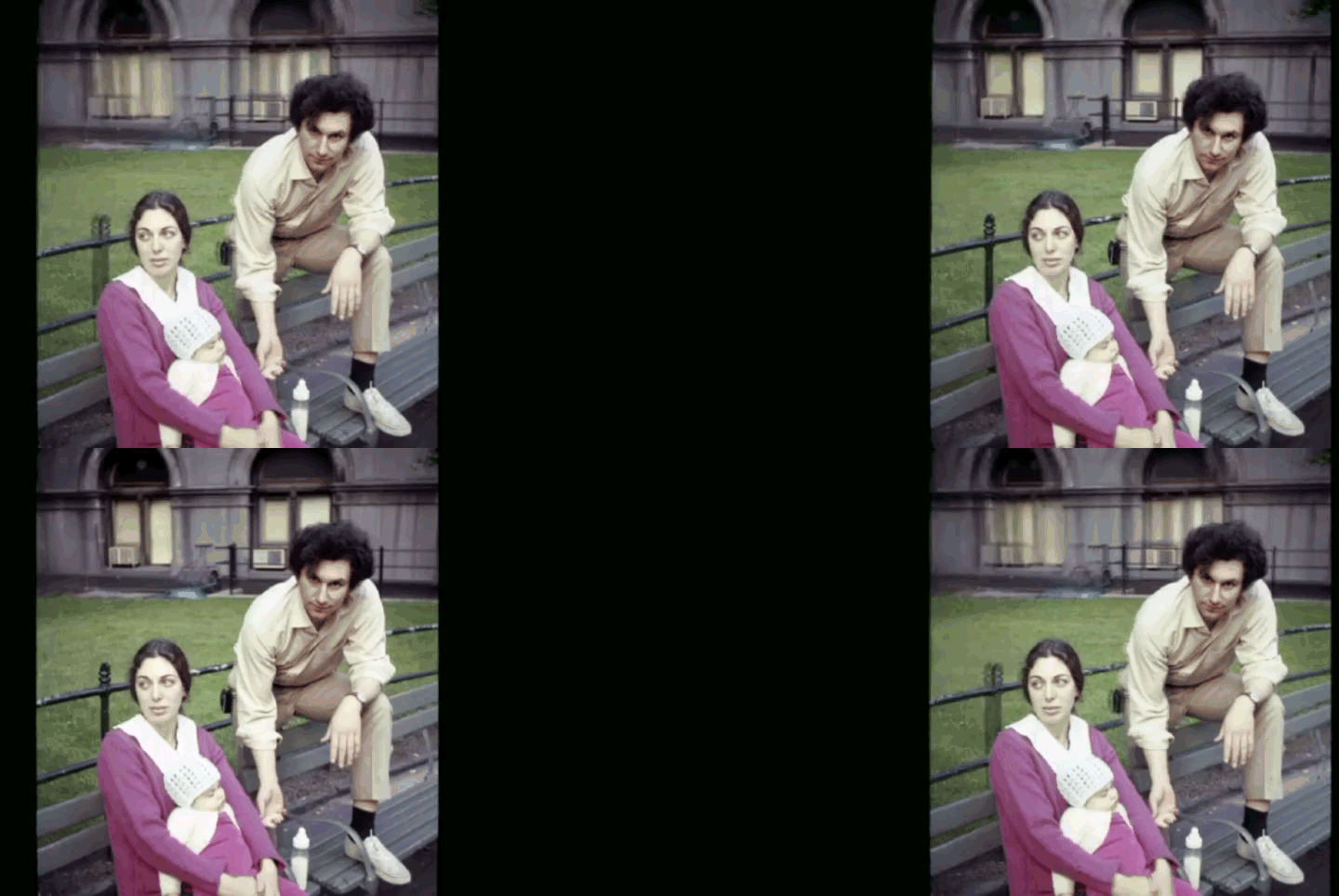
KEN AND FLO JACOBS APPEARING IN CYCLOPEAN 3d: LIFE WITH A BEAUTIFUL WOMAN (2012).
Beginning in the 1990s, Jacobs began experimenting with stroboscopic and 3D effects, as well as digital video. His lifelong fascination with emergent audiovisual technology culminated in the creation of CYCLOPEAN 3D.
As the experimental film programmer at the Tribeca Film Festival from 2003 to 2014, Jon Gartenberg regularly programmed Jacobs’ nervous system films, which led to GME’s funding of CYCLOPEAN 3D. Gartenberg later presented CYCLOPEAN 3D at the International Film Festival of Rotterdam.
In CYCLOPEAN 3D, Jacobs created a new kind of home movie, in which he mined his own archive of stereoscopic still images of family and friends taken between the late 1960s and 1975, and re-presented them as 3D time-based portraits. In addition to Jacobs’ family (his wife Flo and their children Azazel and Nisi), Jacobs also included images of such fellow avant-garde luminaries as Michael Snow, Jonas Mekas, Ernie Gehr, Stan Brakhage, Richard Foreman, and Amy Taubin.
Shortly following Ken’s passing in October 2025, Gartenberg remarked: “For me, CYCLOPEAN 3D is the most directly autobiographical film by Ken, because it is a collage of his friends and family over an extended period of time. The film is also a love letter to Flo, as Ken ends the film with the final title card: We got together in 1961, two weeks before Flo’s 20th birthday.”