NOW PLAYING: The Somatic Lens
/
On the occasion of Women’s History Month in March, GME is pleased to present four short films by pioneering women filmmakers that foreground the human body, particularly within the context of dance and movement.
We are honored to show these films in the Adrienne Mancia Streaming Room. Mancia, a legendary exhibition curator at MoMA, spent her career championing the work of such female cineastes as Shirley Clarke, Agnès Varda, and Maya Deren. Deren’s late-1950s presentation of her magnum opus MESHES OF THE AFTERNOON (1943) proved a particularly formative experience for Mancia. Therefore, we offer Deren’s final work, the dreamlike dance film THE VERY EYE OF NIGHT (1959), alongside rare behind-the-scenes footage of Deren shooting the film, as seen in an excerpt from Martina Kudláček’s 2001 documentary IN THE MIRROR OF MAYA DEREN. We are also pleased to present INTROSPECTION (1941), the debut film of a long-overlooked contemporary of Deren’s, Sara Kathryn-Arledge. Finally, we offer Stella Simon’s vanguard 1927 short HANDE, made in collaboration with Miklos Bandy.
“Meshes of the Afternoon made a huge impression on Adrienne when she first saw it. She went to a screening of the film in the late ’50s or early ’60s, at which Maya Deren presented the film. It might have been at Cinema 16. And it made a huge impression on her understanding of what it meant to do an independent film, what an artists’ cinema meant. Particularly how artists’ films and independent films could be liberating. She said… Deren was wearing black slacks and a very blousy white blouse that you could see through, so you could see Maya’s breasts through the blouse when she spoke to introduce the film. Adrienne said people were saying, ‘You can see her breasts!’ You know, whispering in the audience. And seeing the film after having Maya introduce it that way made a huge impression on her, in terms of the notion of making films being a liberation for the filmmaker and for the audience.” —Ron Magliozzi, MoMA curator
THE VERY EYE OF NIGHT (1959) by Maya Deren
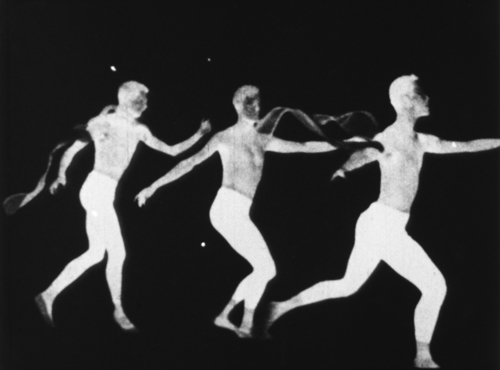
THE VERY EYE OF NIGHT is Maya Deren's last completed film before her death in 1961 at the age of 44. The film was shot from 1952 to 1955 in collaboration with choreographer Antony Tudor. A silent rough cut of the film screened in Port-au-Prince, Haiti in 1955. However, the final cut of the film did not premiere in New York until 1959, at which point a musical score by Teiji Ito had been added. Depicting a group of Metropolitan Opera Ballet dancers against a starry background, the entire film is projected as photographed in the negative, and embodies the dreamlike, avant-garde spirit characteristic of Deren’s earliest works.
THE VERY EYE OF NIGHT is featured in the Re:Voir DVD collection MAYA DEREN: DANCE FILMS, which GME distributes to North American academic institutions, in addition to Deren's A RITUAL IN TRANSFIGURED TIME (1945), A STUDY IN CHOREOGRAPHY FOR CAMERA (1945), and MEDITATION ON VIOLENCE (1948). A RITUAL IN TRANSFIGURED TIME is also featured in the Re:Voir DVD collection MAYA DEREN: EXPERIMENTAL FILMS alongside Deren's MESHES OF THE AFTERNOON (1943) and AT LAND (1944). This DVD collection is also distributed by GME.
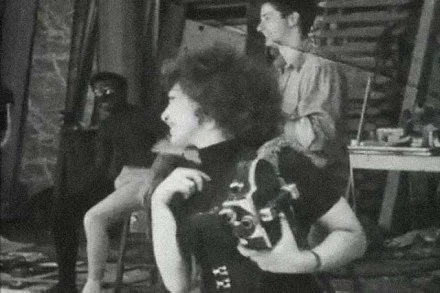
Riveting footage of Deren filming THE VERY EYE OF NIGHT is included in Martina Kudláček’s documentary IN THE MIRROR OF MAYA DEREN, which can be viewed below. (GME distributes Kudláček’s documentary NOTES ON MARIE MENKEN, available as a DVD published by Index Edition).
INTROSPECTION (1941) by Sara-Kathryn Arledge
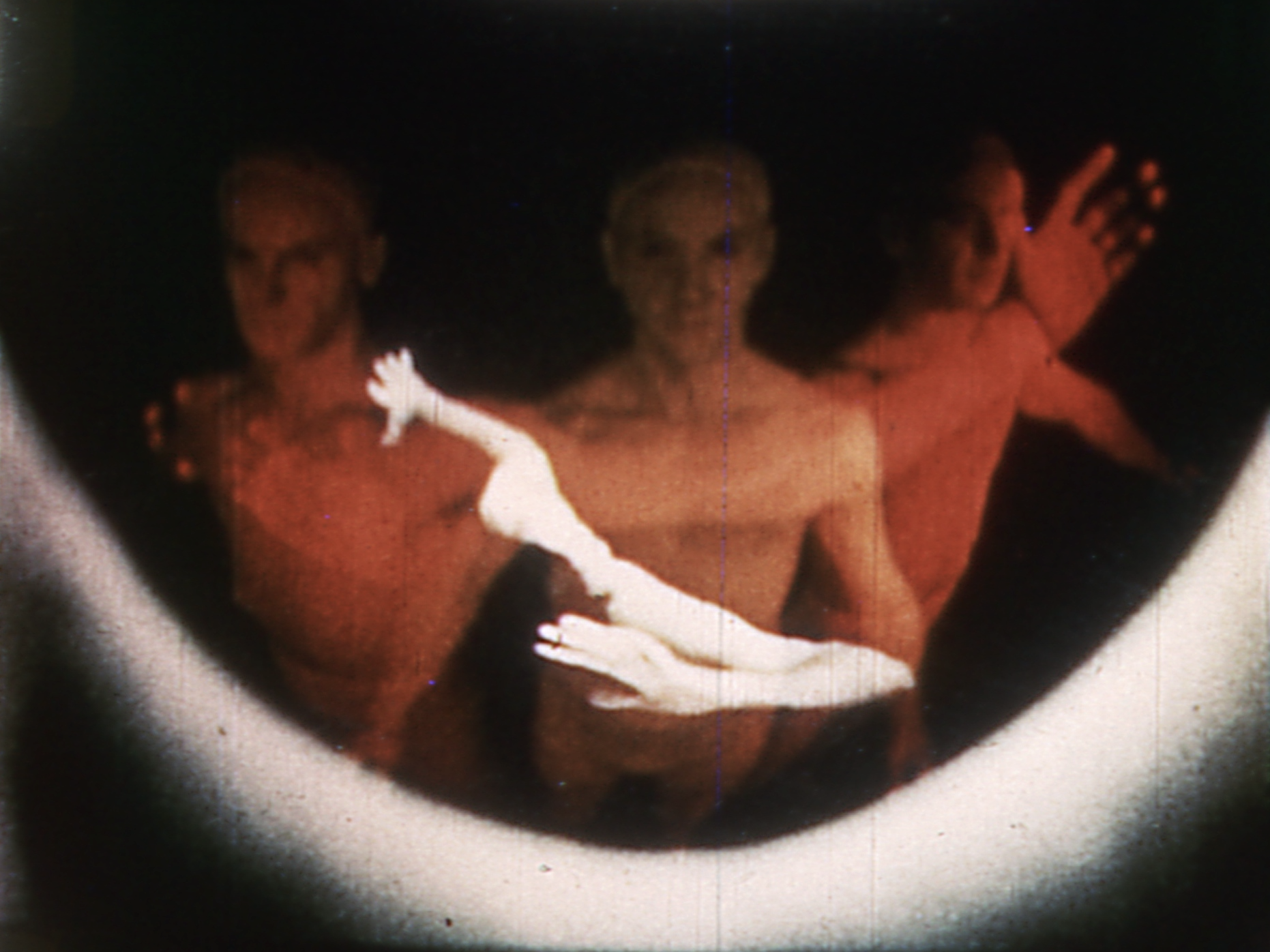
“Arledge's loosely-connected technical and aesthetic experiments utilize dance in an effort to portray ‘time in art.’ The intent was to create a dance that could only be shown on film, a choreography uniquely different from any devised for the stage and one that emerged solely from the film medium.” —Terry Cannon, artist
“Disembodied parts of dancers are seen moving freely in black space... form[ing] a moving and rhythmic three dimensional design and semi-abstract shapes.” —Lewis Jacobs, Avant-Garde Production in America
Sara-Kathryn Arledge began work on her debut film INTROSPECTION in 1941. Made for only $200 and shot over a period of six years, this “highly inventive abstract dance film” employs colored filters, negative film stock, multiple exposures, and reflections in an automobile hubcap of dancers “whose forms are blacked out except for isolated body parts” (Berkeley Art Museum and Pacific Film Archive).
HANDE (1927) by Stella Simon and Miklos Bandy
“The use of human hands as characters in a dance inspired narrative are used to explore female experience and representation. By drawing upon experimental traditions found in international art, film, and photography movements of the 1920s, Simon transforms a simple melodramatic love story into an avant-garde feminist short film.” —Jennifer Wild
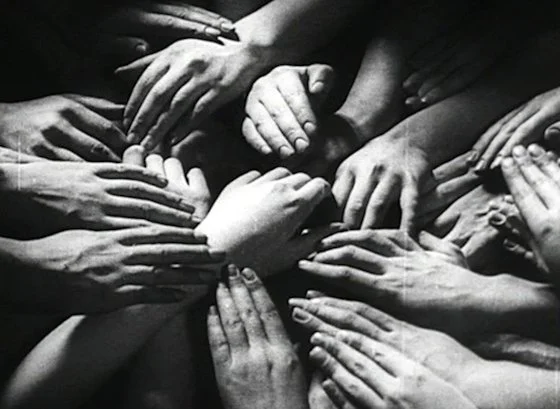
A collaboration between American photographer Stella F. Simon (1878-1973) and Hungarian-born writer Miklós Bándy (1904-1971), HANDE is a short dance film that uses hands — instead of full human bodies — as conduits for choreography and movement. Staged against abstract constructivist backdrops, the hands undulate, cross, and collide with each other. As described by curators at the Musée d'Art et d'Histoire du Judaïsme: “Without dialogue, this abstract ballet seems to tell a universal love story between one, two or three individuals.”