
NOW PLAYING: Mancia E Magnani
/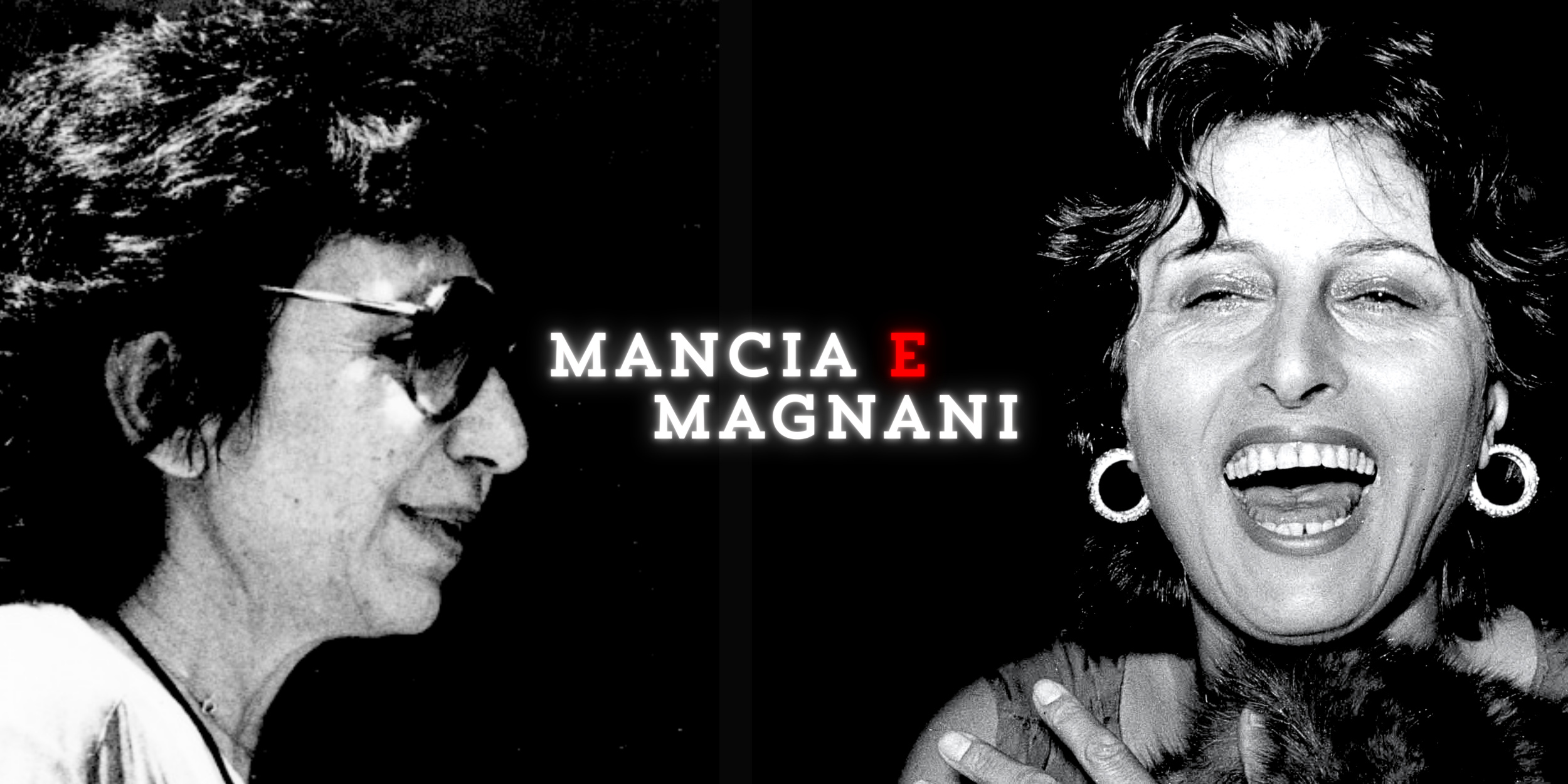
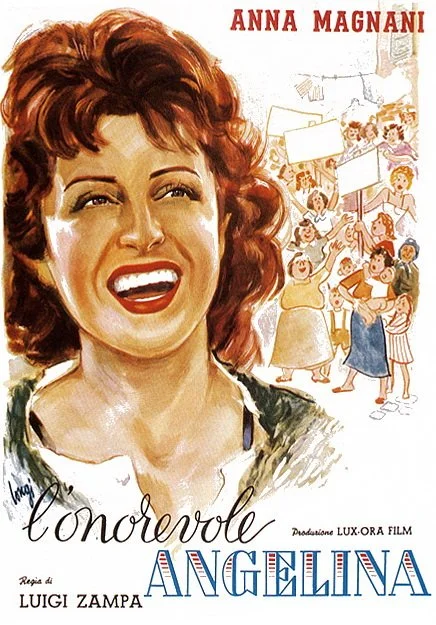
This May in the Adrienne Mancia Streaming Room, GME is pleased to present Luigi Zampa’s 1947 Italian comedy L’ONOREVOLE ANGELINA (THE HONORABLE ANGELINA), starring Academy Award-winner Anna Magnani.
Adrienne Mancia was a fierce champion of Italian cinema. In 1988, she received Italy’s highest civilian honor, the Croce del la Repubblica. On the occasion of this award, Renato Pachetti, then-president of RAI Corporation (New York), remarked: “Adrienne Mancia has probably contributed more than any other person to the introduction of Italian cinema in America. Her knowledge of Italian films is extraordinary.” Gian Paolo Cresci, then-president of SACIS (Rome), the worldwide distribution wing of RAI, echoed Pachetti: “Adrienne Mancia’s generosity and energy have made her a special friend to the members of the Italian film community. No one is more deserving of this special honor.”
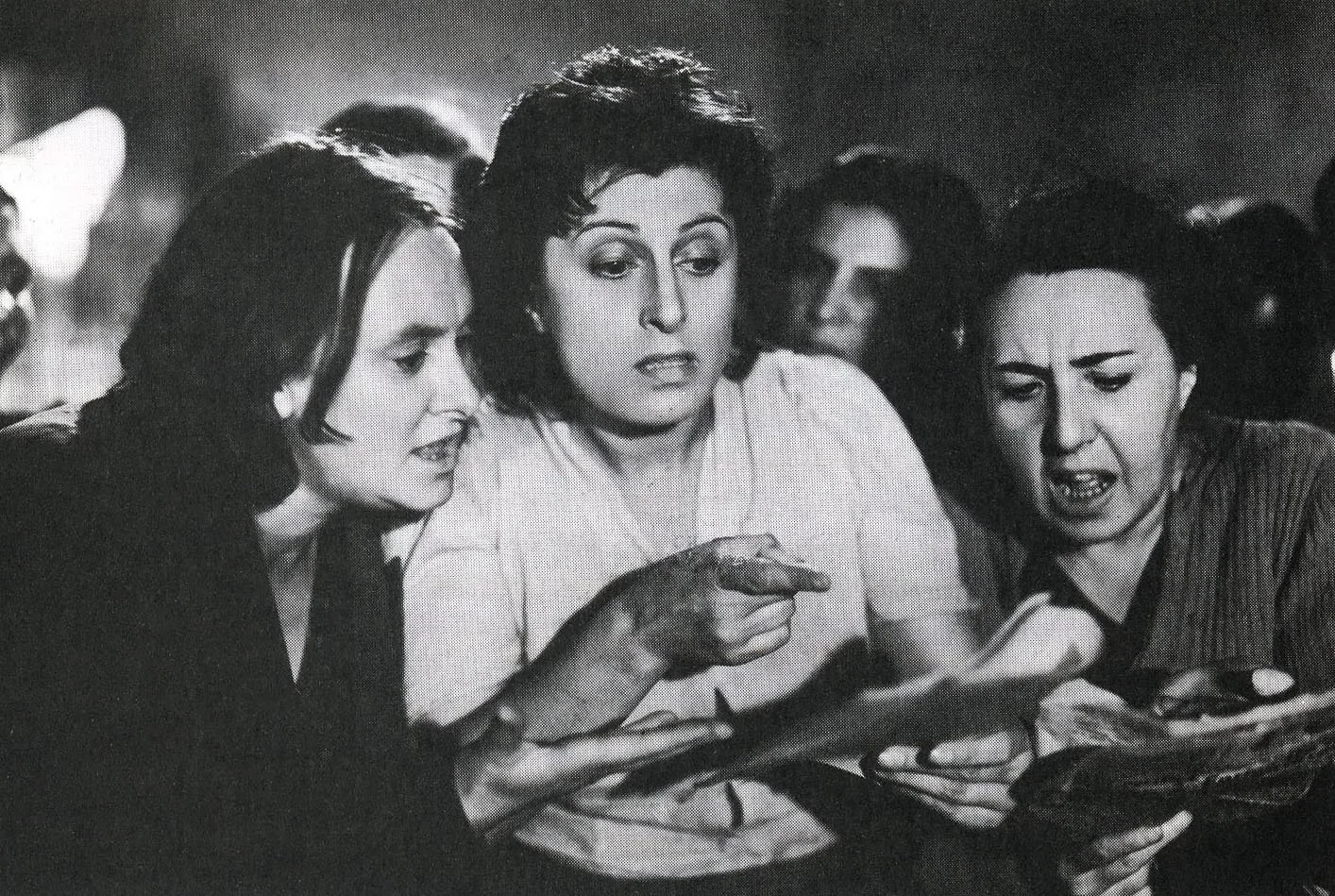
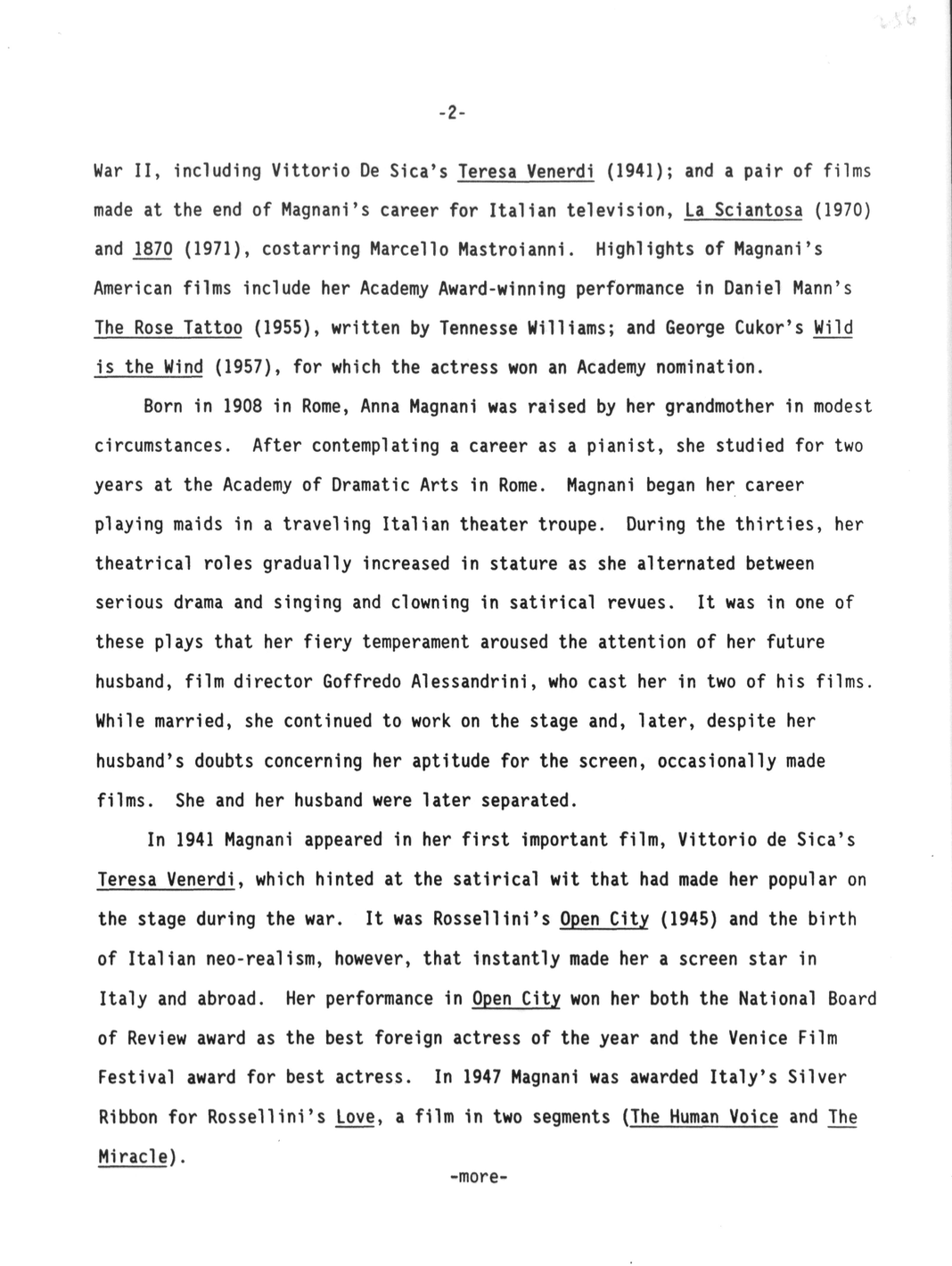
Mancia was also a great admirer of the work of Italian actress Anna Magnani, who achieved international renown in the 1950s as one of the most acclaimed screen thespians of her day. Heralded for her “volcanic” intensity, earthy sensuality, and an appearance and acting style that traded glamour and artifice for naturalism and authenticity, Magnani was a compelling antidote to other major female movie stars of the period (e.g., Marilyn Monroe, Sophia Loren) and achieved enormous success both in Italy and in Hollywood. She eventually won the 1956 Best Actress Oscar for her performance in THE ROSE TATTOO (1955) opposite Burt Lancaster, and was again nominated for her performance in 1959’s WILD IS THE WIND, which co-starred Anthony Quinn.
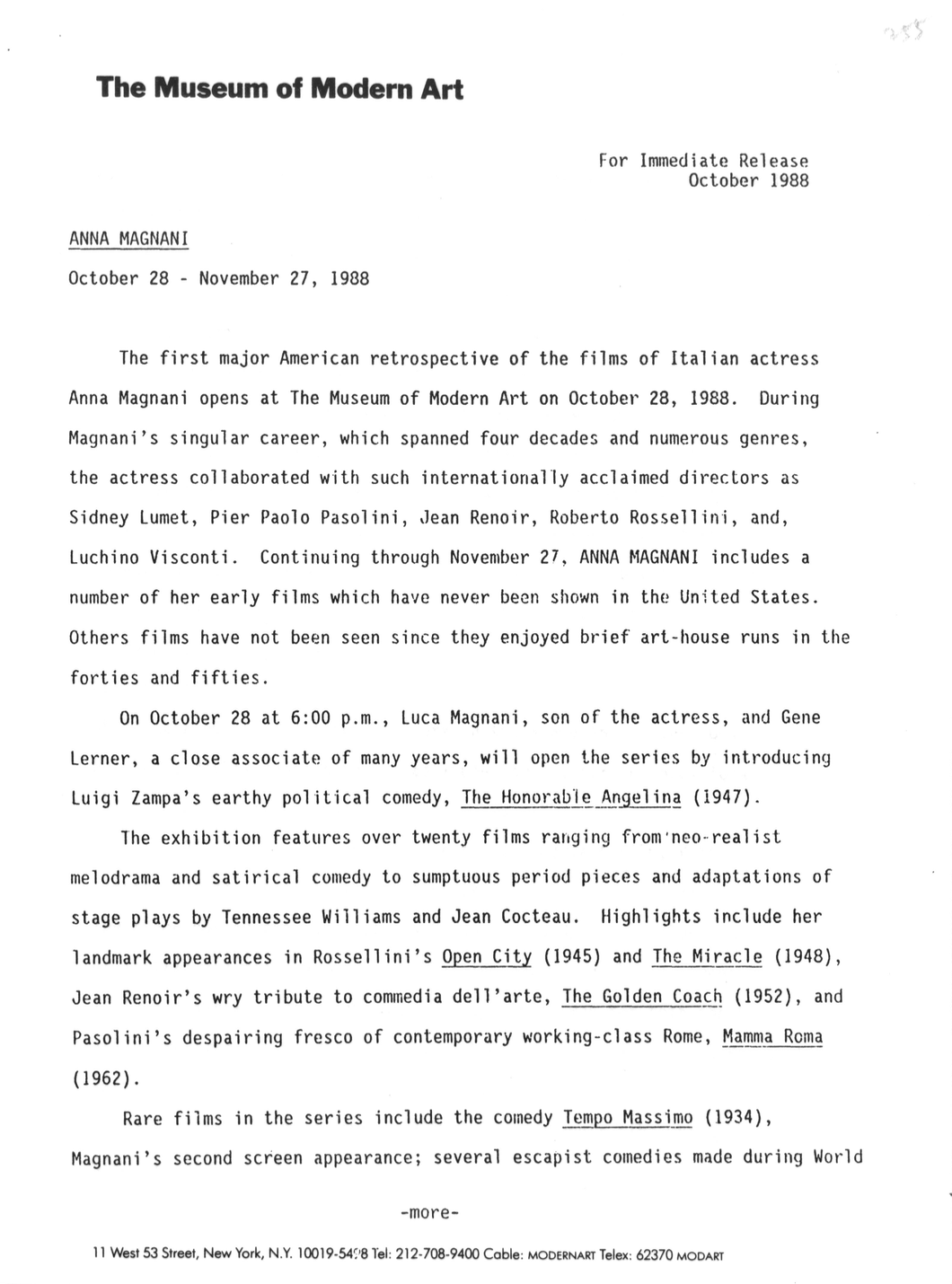
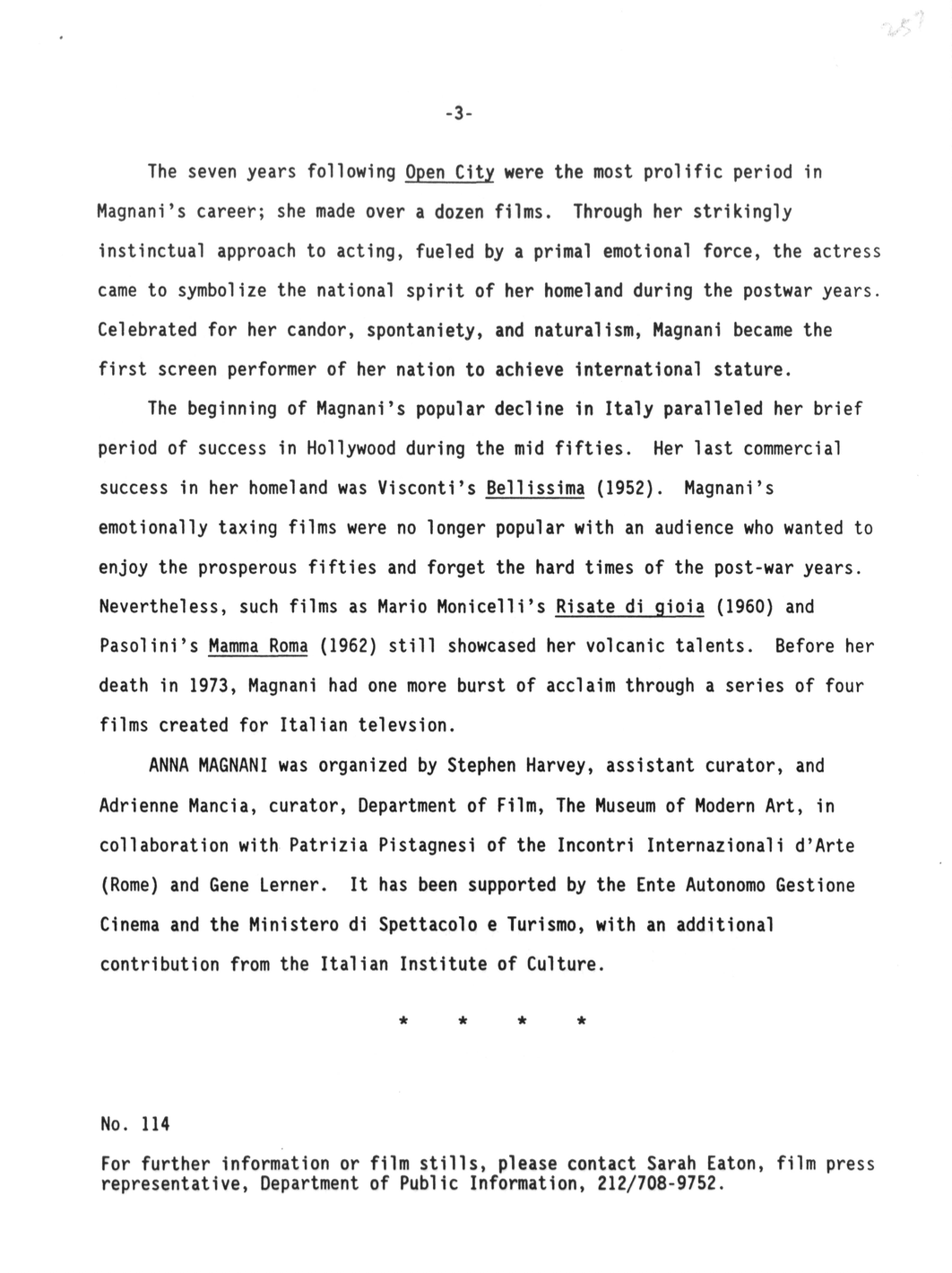
In association with Gene Lerner and the Incontri Internazionali d'Arte (Rome), Mancia and assistant curator Stephen Harvey programmed the first major American retrospective of Magnani’s work at MoMA in October and November of 1988. It was a rare exhibition of the complete film work of an actor. 1947’s L’ONOREVOLE ANGELINA (which is now in the public domain) was selected as the opening night film. It screened at MoMA on October 28th, and was introduced by Lerner alongside Magnani’s son, Luca. (Scans of the typewritten press release and program note for Mancia and Harvey’s retrospective can be read below).
ANGELINA was something of an outlier in Magnani’s filmography. A performer best known for her dramatic work, Zampa’s film afforded Magnani an opportunity to act in a comedy. The film follows the titular Angelina Bianchi, an impoverished mother of five. While raising her children in the slums, she leads a band of women against a black-market peddler who is withholding their food rations. The MoMA program note for Mancia and Harvey’s retrospective dubs ANGELINA an “earthy political comedy” that imbues a rebel-rousing sense of humor into an otherwise somber and politically-trenchant narrative.
As the film’s beating heart, Magnani carries ANGELINA, and the critics sang her praises. She eventually won the Volpi Cup for Best Actress at the Venice Film Festival. In 2008, ANGELINA was included on the Italian Ministry of Cultural Heritage's 100 Italian Films to Be Saved: a list of 100 films that “changed the collective memory of the country between 1942 and 1978.”
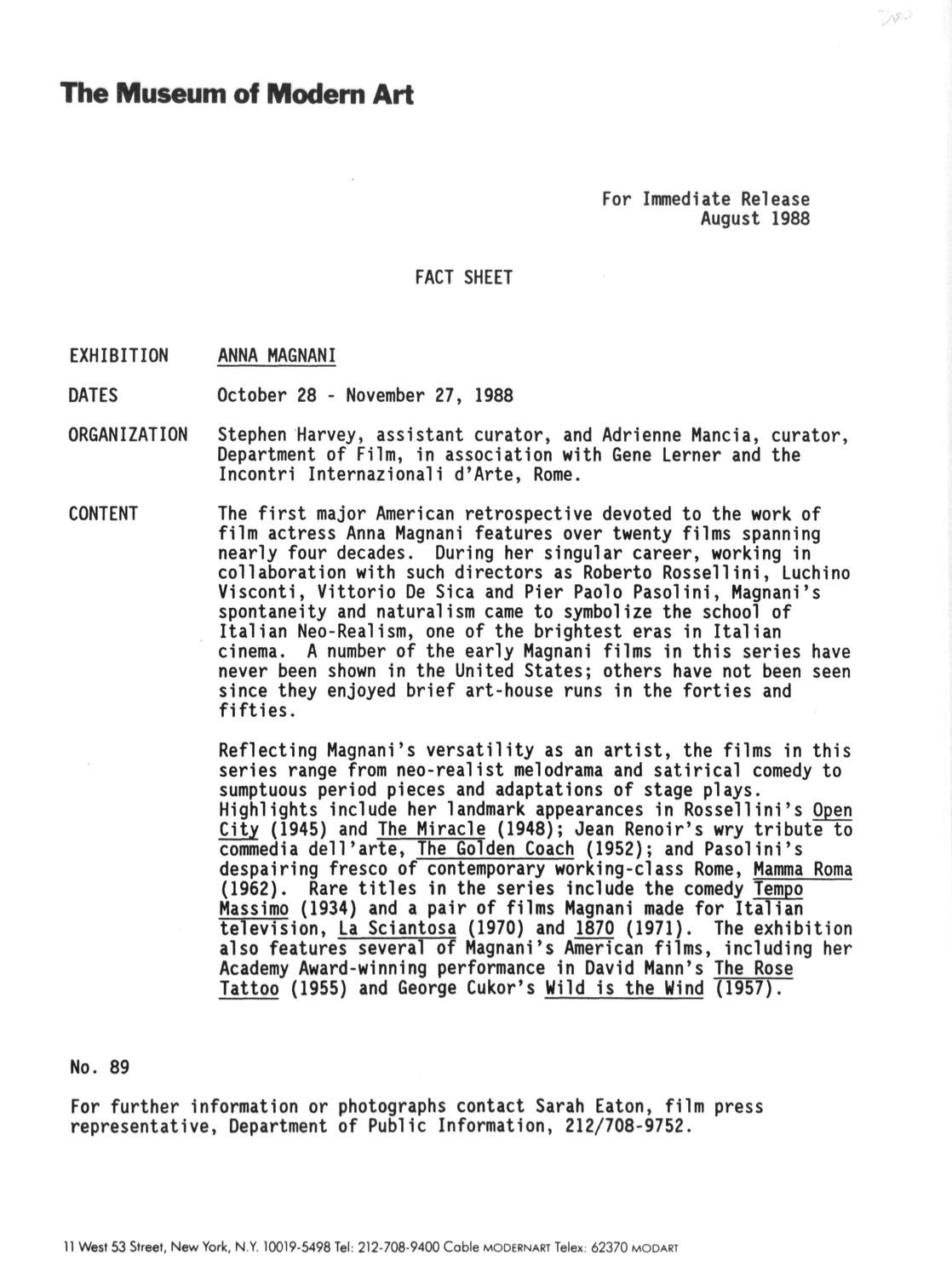
For over 30 years, Adrienne Mancia worked as a curator in the Film Department of The Museum of Modern Art, where she became one of the most respected figures in her field. Decades before the digital age, Mancia traveled to festivals and archives around the world and discovered overlooked and under-seen gems of international cinema. She subsequently brought these films back to New York City and introduced them to stateside audiences who would not have been able to access them otherwise.
Adrienne’s first job in the field was at Contemporary Films, where she worked alongside Leo Dratfield and was involved in the distribution of many foreign films in the United States… During my career at MoMA as a film archivist, Adrienne achieved renown as the premiere film exhibition curator worldwide. Her interest in cinema had no bounds, incorporating animation, experimental films, documentaries, and narratives. Her programming skills flourished during a period before the age of videotape, internet, and niche movie channels so that the recognition for the films that she curated at MoMA garnered an outsized importance in terms of the New York film culture and beyond.
—GME President Jon Gartenberg
We hope you enjoy L’ONOREVOLE ANGELINA and GME’s celebration of Adrienne Mancia’s role in furthering the legacy of Anna Magnani and classic Italian cinema at large.