
NOW PLAYING: Warren Sonbert's AMPHETAMINE and WHERE DID OUR LOVE GO?
/On the occasion of Pride Month and what would have been Warren Sonbert’s 79th birthday, GME presents the artist’s first two films — AMPHETAMINE and WHERE DID OUR LOVE GO? (1966) — to view for free in the Adrienne Mancia Streaming Room.

In his first films, [Sonbert] uniquely captured the spirit of his generation, and was inspired both by his university milieu and by the denizens of the Warhol art scene. —Jon Gartenberg
Warren Sonbert (1947—1995) was one of the seminal figures working in American experimental cinema. He started making films as a student at New York University in the mid-1960s, when he was “in” with Andy Warhol’s crowd (Gerard Malanga and Rene Ricard are featured in his films), and at just 20 years old, he had a career retrospective at Jonas Mekas’ Film-Makers’ Cinematheque, which was reviewed in Variety. Later, in the 1980s and early 1990s, Sonbert was a major figure of the avant-garde, and his films were regularly shown at the New York Film Festival as well as other venues worldwide.
Sonbert’s early films have been the subject of renewed scholarly and popular interest in recent years. In particular, his 1966 debut AMPHETAMINE and its follow-up WHERE DID OUR LOVE GO? have been analyzed and celebrated for their significance as rare, pre-Stonewall documents of queer euphoria and community.

CLICK THE IMAGE ABOVE TO WATCH AMPHETAMINE.
Described by critic James Stoller in the 1967 publication New American Cinema: A Critical Anthology as “a heart-stopping film… beautiful and pure,” AMPHETAMINE was made together with Wendy Appel, Sonbert’s classmate at NYU, and depicts a group of preppy young men in an enclosed space who take intravenous drugs, kiss, and cuddle, all while listening to the Supremes’ 1964 album WHERE DID OUR LOVE GO? (hence the title of Sonbert’s next piece). As noted by Gary Morris of Bright Lights Film Journal, “This 10-minute black-and-white ode to sex and drugs echoes the work of Warhol and [Paul] Morrissey in luring the viewer into a self-consciously decadent, queer, closed space… The sense of transgressive pleasures is intense.”
AMPHETAMINE has found new life in the 21st century as a rediscovered “cult classic” of Sixties queer underground cinema. In 2019, the queer film zine Dirty Looks published an experimental personal essay by Johnny Ray Huston, about Huston's euphoric experience watching Sonbert’s AMPHETAMINE for the first time. In September 2023, AMPHETAMINE screened in the exhibition Billy Bultheel & James Richards: Workers in Song at WIELS in Brussels. Between 2024 and 2025, Dr. Maurice Nagington’s publication The Moral Lessons of Chemsex: A Critical Approach (Routledge), Juan Suarez’s book Experimental Film and Queer Materiality (Oxford University Press), and GME associate Matt McKinzie's film program The Motown Sound and the Queer Underground (presented by Spectacle Theater and The Film-Makers' Cooperative) invoked AMPHETAMINE as a key filmic text integral to discourse surrounding 1960s avant-garde cinema, queer representation on film, popular music, chemsex, and connection.
Earlier this month, AMPHETAMINE screened at the Brooklyn Academy of Music (in a Pride Month program also curated by McKinzie) titled Out of the Closet and Into the Co-op: Early Queer Cinema at The Film-Makers’ Cooperative. This screening placed Sonbert’s film in conversation with other early queer works by such avant-garde filmmakers as Barbara Hammer, Jack Smith, Edward Owens, and Jean Genet.

CLICK THE IMAGE ABOVE TO WATCH WHERE DID OUR LOVE GO?.
As with AMPHETAMINE, WHERE DID OUR LOVE GO? was featured in McKinzie’s 2024 program The Motown Sound and the Queer Underground. Of the film, McKinzie wrote: “The young gay filmmaker follows his friends (many of them involved with Warhol’s factory scene, and some of whom appeared in AMPHETAMINE) around New York City: at gallery exhibitions, and in artist lofts, studios, and storefronts. His colorful images of camaraderie and creativity… are accented by moments of eroticism and humor… [and] the result is a kind of extended music video in which Sonbert reflects the zeitgeist of his community and the times.” McKinzie concluded by characterizing WHERE DID OUR LOVE GO? as “a queer-coded love letter to friendship and the mid-‘60s downtown art scene, named for one of the Supremes’ biggest singles (and LPs) and enlivened by artists who both influenced and echoed the ‘Motown sound.’”
On June 11th, WHERE DID OUR LOVE GO? was screened on a loop at the Morgan Library in their Pride Month event Morgan After Hours: Pride. As described in the Library's program note, the film sees Sonbert “chronicle his community at work and play in the Janis and Castelli galleries, Warhol’s Factory, the Bleecker Street Cinema, and other iconic spaces for the artistic and social milieu of New York City in the 1960s.” In addition to Sonbert's film, Morgan After Hours: Pride consisted of dancing, drinks, live DJ sets, and artwork set against the Library's Gilded Age glamour.
For those who missed the aforementioned shows at BAM and the Morgan Library, we are pleased to present our new digital restorations of these two key Sonbert films in the Adrienne Mancia Streaming Room.
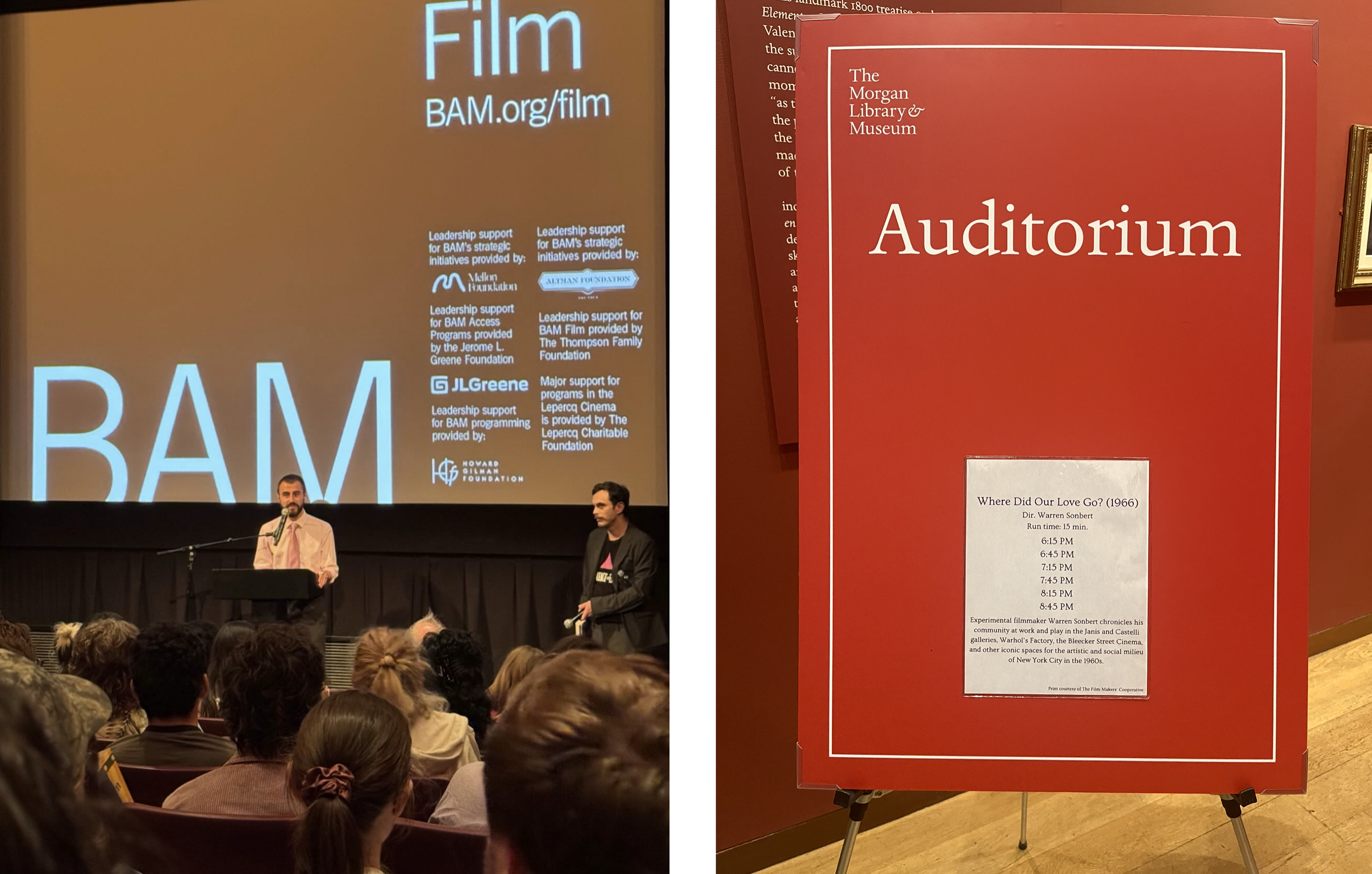
LEFT: MATT MCKINZIE AND CONOR WILLIAMS PRESENTING OUT OF THE CLOSET AND INTO THE CO-OP, WHICH FEATURED SONBERT’S AMPHETAMINE, AT THE BROOKLYN ACADEMY OF MUSIC ON JUNE 15tH. RIGHT: THE AUDITORIUM SIGN LISTING THE SHOWTIMES FOR SONBERT’s WHERE DID OUR LOVE GO? AT THE MORGAN LIBRARY’S PRIDE MONTH EVENT ON JUNE 11th.
The Estate of Warren Sonbert has previously named Gartenberg Media Enterprises as the custodian of his legacy. Since Sonbert’s untimely passing in 1995, GME has worked on an extensive project to preserve, distribute and curate career retrospectives of his films on an international basis. In addition, original documents from the paper archive of his writings, which are now housed at Harvard University, were reprinted in a special 2014 issue of Framework: The Journal of Cinema and Media. A second issue of Framework, consisting of contemporaneous writings about Sonbert’s early films, was published in 2024. Jon Gartenberg was Guest Editor for both Framework issues.
For more information about Sonbert and his films, please contact info@gartenbergmedia.com.